“How many times can I refill my acrylic nails before I need a new set?” I think the better question is: What condition are the old acrylic and the natural nails in? A set does not automatically need to be removed after a fixed number of weeks or refills. But there are signs that tell me it is time to stop adding product and inspect what is underneath.
Is there a rule for how often to replace acrylic nails?
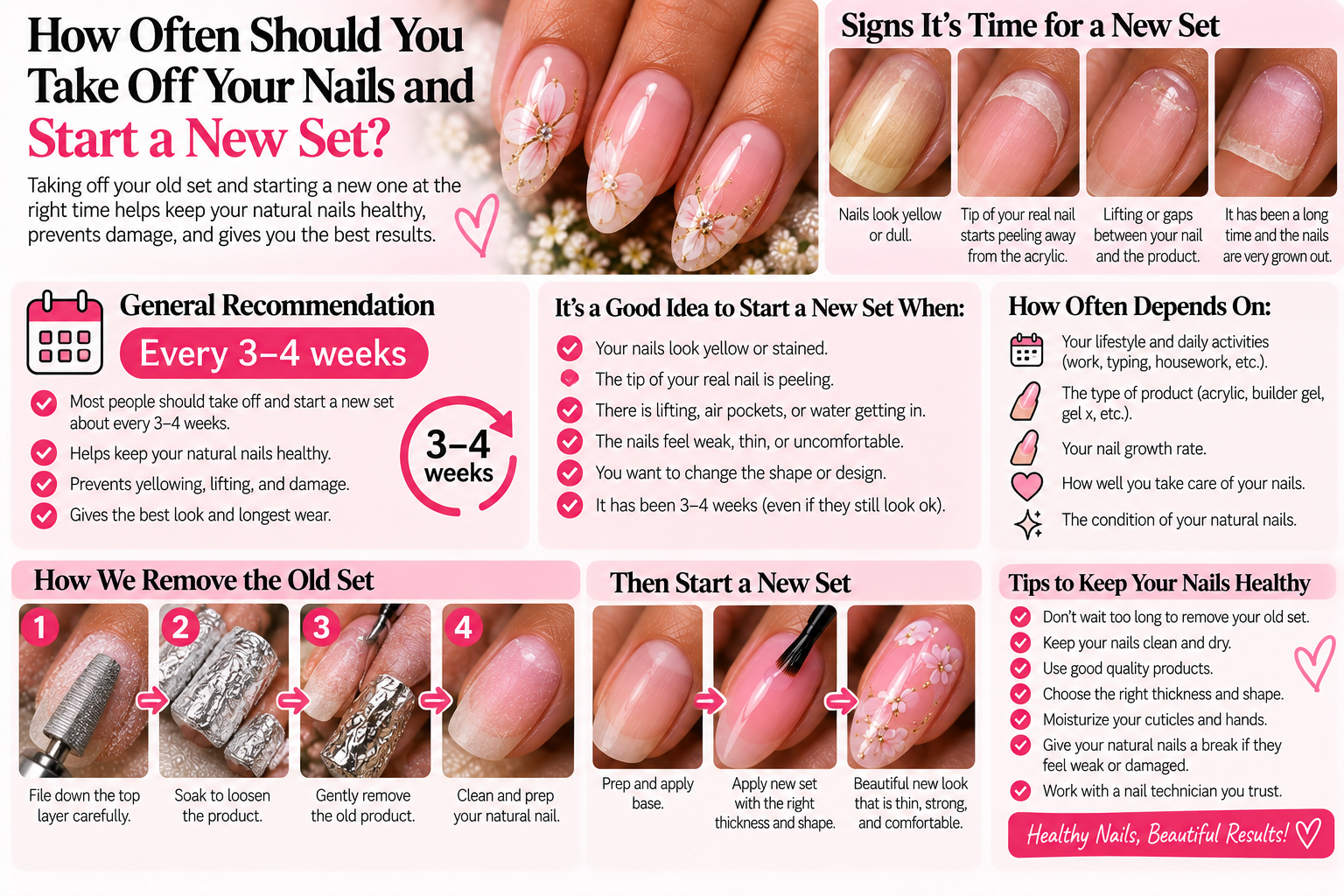
There is no universal rule that every acrylic set must be removed after a certain number of fills. Many clients return for maintenance roughly every two to three weeks, depending on growth and wear. A properly maintained set may be suitable for additional fills when the enhancement is stable and the natural nail appears healthy. Repeatedly filling damaged or lifting acrylic, however, is not good maintenance.
Warning sign 1: The old acrylic looks yellow
Yellowing can have several explanations, including staining from polish, dyes, smoking, product aging or changes to the natural nail. It is not proof of an infection by itself. But if the color appears beneath a lifting enhancement, develops with a change in texture, or is accompanied by pain, odor, thickening or unusual green, brown or dark discoloration, I would not simply cover it with fresh acrylic. The nail should be assessed, and suspicious changes should be evaluated by a healthcare professional.
Warning sign 2: The natural nail starts separating from the acrylic at the tip
Sometimes the free edge of the natural nail pulls away from the acrylic overlay, leaving a gap between the two materials. This is enhancement lifting or separation, and it can trap moisture and debris. Adding more acrylic on top does not repair the detached bond. The loose material needs to be properly addressed, which may require removing part or all of the enhancement.
Important: Is the acrylic lifting, or is the natural nail lifting from the nail bed?
These are different problems. If the acrylic separates from the natural nail plate, the enhancement has lifted. If the natural nail plate itself separates from the skin beneath it, that is called onycholysis. The detached portion of a natural nail does not simply reattach by being glued or covered. Causes can include trauma, irritation and some nail conditions or infections. Do not put a new enhancement over suspected onycholysis; seek evaluation, especially if the area is spreading, discolored or painful.
When I would recommend removing an old set
- There is significant or repeated lifting, especially near the free edge or sidewalls.
- Old product has cracks, trapped debris or gaps that cannot be safely corrected during a normal fill.
- The enhancement has become bulky, uneven or structurally difficult to rebalance.
- There is unexplained discoloration or a change in the natural nail that needs assessment.
- The natural nail appears damaged or is separating from the nail bed.
- The customer wants a major change in length, shape or enhancement system that requires safe removal.
Some situations call for partial product removal and rebuilding; others call for taking the full set off. The right decision depends on the condition of each nail.
When is a refill still okay?
If the acrylic remains firmly attached, there are no concerning changes to the natural nail, and the structure can be properly balanced, a professional fill may be reasonable. During maintenance, any lifting should be removed rather than sealed over. The goal is not to keep an old set forever; it is to maintain a safe, stable enhancement.
How to remove acrylic safely
Never pry, peel or force acrylic off your natural nails. A nail technician should use removal methods appropriate for the product, taking care to avoid unnecessary filing of the natural nail. If the nail is painful, bleeding, swollen or appears infected, medical assessment is more important than immediately applying another set.
Does the nail need a break between sets?
Natural nails do not need to “breathe” in the way skin or lungs do. However, if the nail plate is thinned, damaged, irritated or separating, leaving it free of enhancements while it recovers may be appropriate. A new set should not be used to hide a problem that needs treatment.
My approach: know when to stop refilling
I want customers to enjoy beautiful nails, but I also want them to understand that a refill is not always the right answer. If an old set is lifting badly, changing color or separating from the natural nail, I would rather assess it and discuss safe removal than keep covering the problem.
My message: Don't judge an acrylic set only by how long you've worn it. Watch its condition. When the bond or natural nail is compromised, starting fresh—or allowing the nail to recover—can be the better choice.
Frequently asked questions
Should I remove acrylic nails after three fills?
Not automatically. There is no fixed refill count that applies to everyone. The decision depends on lifting, nail health, product condition and whether the structure can be maintained safely.
Does yellow acrylic mean fungus?
No. Yellowing can result from staining or product changes, but unexplained discoloration should be checked, particularly with lifting, thickening, odor or discomfort. Only an appropriate assessment can identify the cause.
Why is my natural nail peeling away from the acrylic tip?
The acrylic-to-nail bond may be lifting, sometimes after wear, impact or changes in nail shape. If the natural nail itself is separating from the nail bed, that is a different concern and needs evaluation.
Can I just glue down a lifted acrylic nail?
Do not glue down a lifted area that may contain moisture or debris. Have it professionally assessed and corrected or removed.
More advice from Kevin
Learn why acrylic nails lift, how I build thin-looking but strong nails, and how I approach builder gel maintenance. Browse my nail work for design inspiration.
Educational information only, not a medical diagnosis. If you notice natural nail separation, persistent discoloration, pain, swelling or suspected infection, seek evaluation from a qualified healthcare professional before applying new enhancements. Check current services.