Can acrylic nails be too thin?
Yes. If too much material is removed from the stress area, an acrylic extension may be more likely to crack or break. The aim is not the thinnest nail possible: it is a slim-looking nail with enough structure for its length and shape. Learn more about natural-looking acrylic nails and habits that reduce breakage.
“I want my nails thin and natural, but I don't want them to break.” That's a request I hear from customers. My approach is not to make the whole nail thick. I build the necessary support in the right area and keep the rest refined, so the finished set looks natural without giving up its structure.
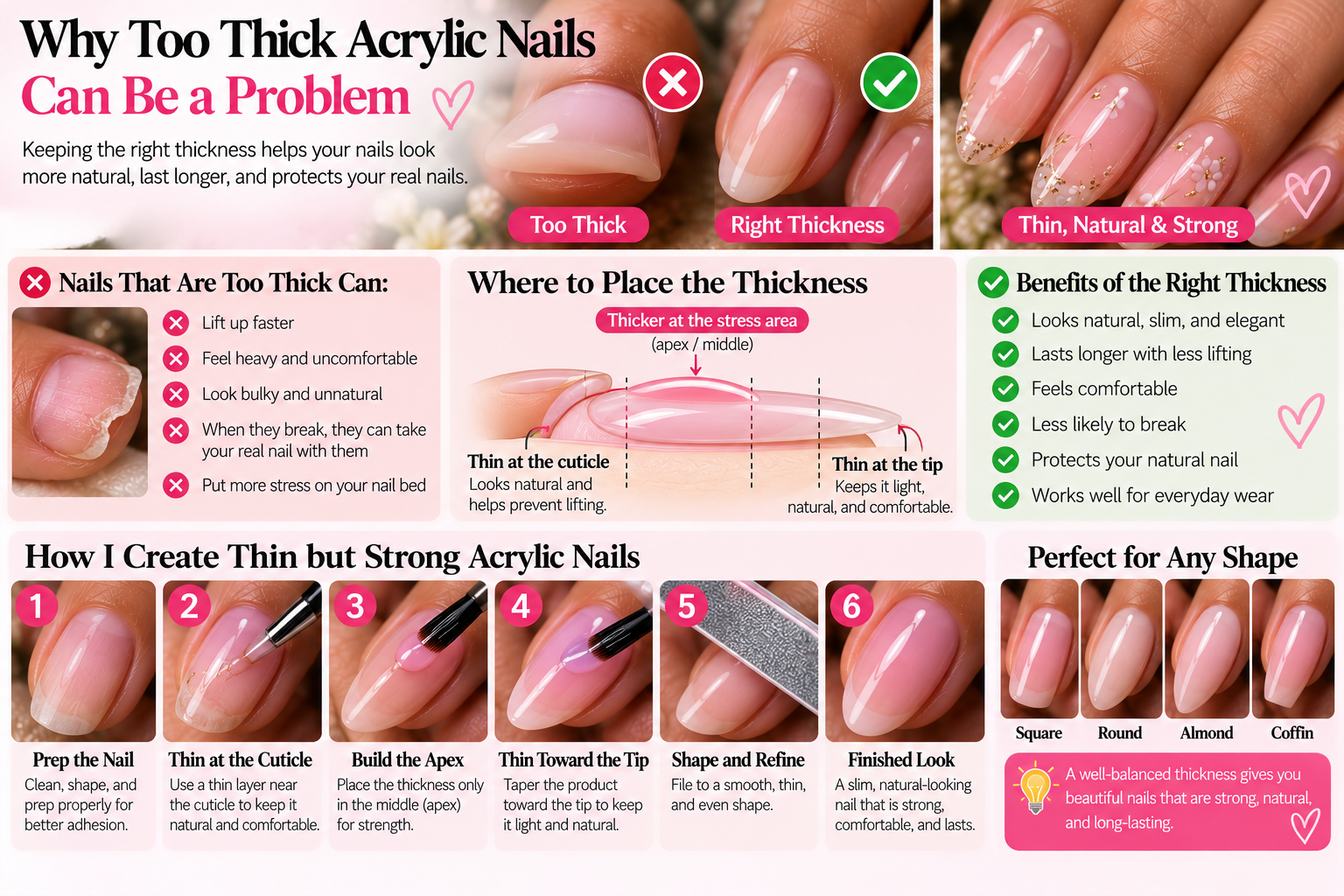
I often compare it to the human body: strength is not distributed in exactly the same way everywhere. Different areas have different jobs. An acrylic nail also needs the right proportions. More product everywhere does not automatically mean a better nail.
The secret is structure, not overall thickness
An enhancement needs enough material to resist the forces of daily use, but that material should be shaped intentionally. A nail with too much bulk near the cuticle and sides can look wide or heavy. A nail that is filed too thin through its stress area can be more likely to crack. The goal is balanced architecture—a slim-looking profile with support where the nail needs it.
What is the apex of an acrylic nail?
The apex is the high point of the enhancement's structure when viewed from the side. It helps distribute stress along the nail. Its ideal placement and size vary with the length, shape, natural nail and the technique being used. It should blend smoothly into the surrounding nail rather than appear as an abrupt lump.
Where should acrylic be thicker and where should it be thinner?
For many sculpted acrylic designs, the stress area needs more structural support than the product near the cuticle. The cuticle area should transition smoothly without a bulky ridge. Sidewalls should be neat and proportional, while the free edge needs an appropriate thickness for its length and shape—not a fragile, paper-thin edge. This is a matter of proportions, not one fixed thickness measurement that works for every customer.
Why not make the whole nail extra thick?
Uniformly heavy application can make the set look unnatural and feel cumbersome. It may also require more filing to refine the shape. Extra thickness alone does not fix poor balance, weak sidewalls, unsuitable length or lifting caused by preparation problems. Thoughtful placement of product is more useful than simply adding more.
Why not file the whole nail very thin?
Removing too much product from the stress area can reduce the enhancement's ability to withstand bending and impact. Thin-looking is not the same as thin everywhere. Good structure is particularly important as extensions get longer, because longer nails experience more leverage when they catch or are bumped.
How I aim for a natural-looking, durable set
- Choose a practical length and shape. I consider the customer's preferred look and how they use their hands.
- Build support intentionally. I place and shape product so the apex and stress area have the support appropriate for that set.
- Keep the perimeter refined. I aim for a smooth transition at the cuticle and neat sidewalls rather than unnecessary width.
- Check the nail from several angles. The top view, side profile and front view all matter for proportion.
- Balance appearance with durability. I avoid promising that an extremely thin or extra-long nail will never break.
Does the right apex prevent every break?
No. Even well-structured nails can crack or break after a strong impact, and durability also depends on nail condition, application, maintenance and daily habits. A severe snag can injure the natural nail or nail bed. If a nail is painful, bleeding or separating from the nail bed, seek medical care instead of covering the injury.
How to ask your nail technician for this look
Try saying: “I want a slim, natural-looking acrylic set with a smooth cuticle area, clean sidewalls and enough structure to be durable.” Bring photos showing the side profile as well as the top. That gives your technician a clearer target than simply saying “make it thin.”
Frequently asked questions
Can thin-looking acrylic nails still be strong?
Yes. With appropriate structure, length, product and application, a nail can look refined without being uniformly thin. No enhancement is unbreakable.
Does every acrylic nail need a big apex?
No. The amount and placement of support depend on the length, shape and nail. A short overlay and a long extension will not have identical structural needs.
Why do my nails crack even when they look thick?
Thickness alone does not guarantee strength. Product placement, balance, stress points, length, application and impact all play roles.
Can acrylic be too thin near the tip?
Yes. Over-filing the free edge or stress area can leave the extension vulnerable, especially on longer nails.
More advice from Kevin
Read why acrylic nails can look bulky and what causes acrylic lifting. You can also browse my nail work to see design ideas.
This article shares general nail education and my approach to acrylic structure. Every client's nails are different. View current services or request an appointment.