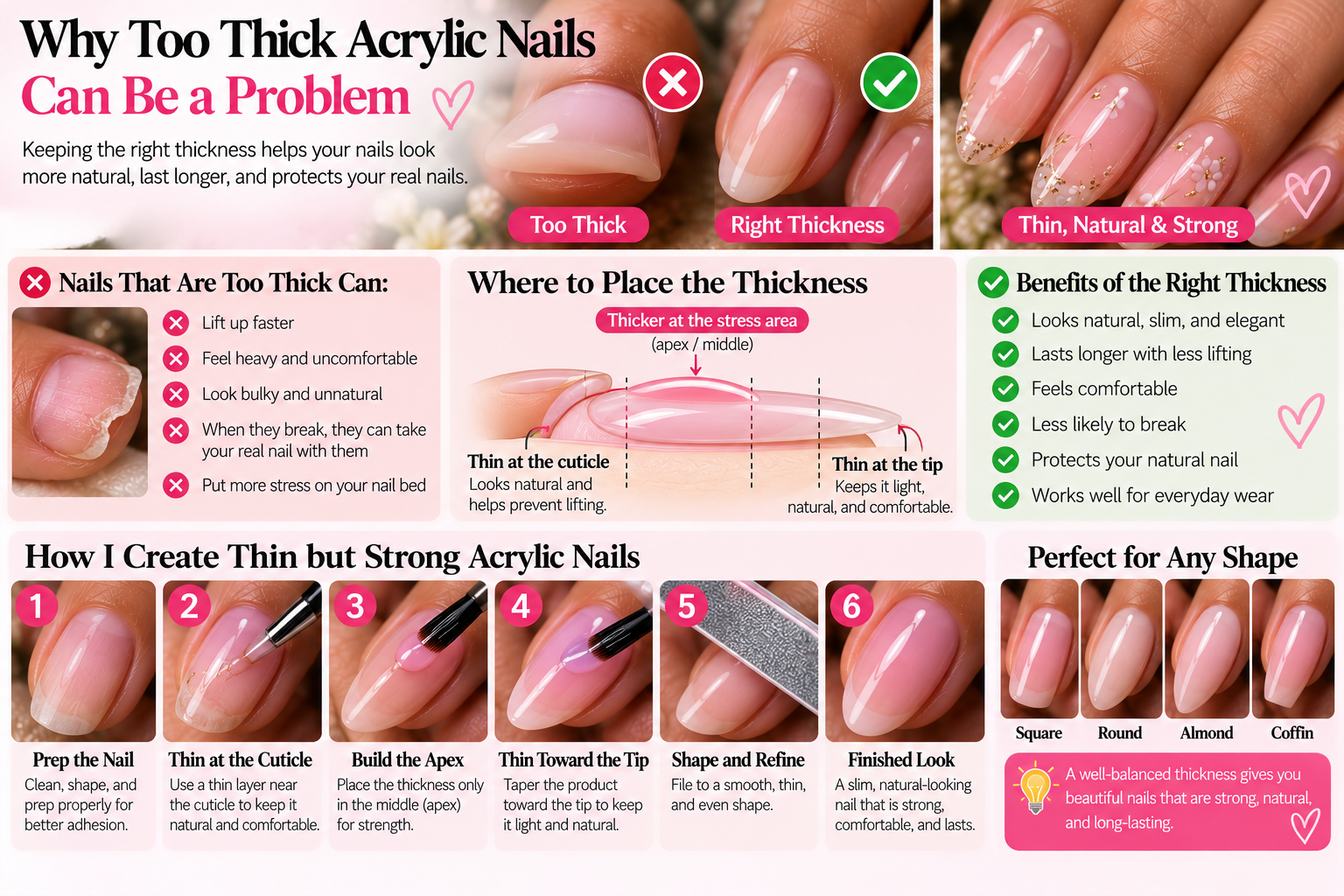
“If my acrylic nails are really thick, won't they be stronger?” I hear versions of this question from customers. My answer is that more acrylic everywhere does not automatically make a safer or better nail. A very bulky or long enhancement can be difficult to wear, and when it catches on something, the force may be transferred to the natural nail underneath.
What happens when an acrylic nail catches or breaks?
An acrylic enhancement is attached to the natural nail plate. If it catches on a door, a drawer or clothing, the extension can act like a lever. Depending on the impact, the acrylic may crack, lift or pull on the natural nail. A severe injury can split or partially detach the natural nail and damage the sensitive nail bed beneath it. Not every broken acrylic nail causes a nail-bed injury, but the possibility is real.
Why overly thick acrylic can be a problem
Excessive bulk can make an enhancement heavier-looking and harder to manage. In some situations, a thick, rigid extension may resist breaking while transmitting more force to the attached natural nail during a snag. However, thickness alone does not determine injury risk. Length, shape, adhesion, material properties, where the nail catches and the direction and strength of the impact are all important.
Thick everywhere is not the same as strong in the right place
When I create an acrylic set, I focus on balanced structure. The apex and stress area need appropriate support, while the cuticle transition and sidewalls should be smooth and refined. The free edge should not be filed dangerously thin, either. My goal is not the thinnest possible nail: it is a natural-looking enhancement with enough support for its length and shape, without unnecessary bulk.
Long nails create more leverage
Even a well-built nail can be injured in a hard impact. Longer extensions generally provide more leverage when they catch. For someone who frequently uses their hands at work, cares for children or does physical tasks, a shorter and more practical length may reduce snagging risk. Nail shape and daily habits matter as much as appearance.
Can acrylic be too thin, too?
Yes. Removing too much material from the stress area can leave the enhancement prone to cracking. The solution to bulky nails is not to file every part paper-thin. Proper proportions and suitable length are more useful than either extreme.
Signs a broken acrylic nail needs attention
If an acrylic nail breaks and you notice significant pain, bleeding, swelling, a split natural nail, or the nail lifting away from the nail bed, do not pull the enhancement off or glue it back down. Protect the finger from further impact and seek prompt medical assessment. A nail-bed injury may need treatment. Do not apply fresh acrylic or gel over broken skin or a suspected infection.
How to reduce the chance of painful nail breaks
- Choose a manageable length. Match your nail length to your daily activities.
- Ask for balanced structure. A smooth cuticle area and properly supported stress area matter more than excessive thickness.
- Maintain your nails regularly. As the natural nail grows, the enhancement's balance changes.
- Never use nails as tools. Avoid prying, scraping or opening objects with extensions.
- Address lifting or cracks early. Have damaged enhancements professionally assessed rather than ignoring them.
- Communicate discomfort. Tell your technician if the set feels unusually heavy, catches frequently or hurts.
My approach: natural-looking nails with thoughtful strength
I often tell customers that strength should be placed where it is needed, just like different parts of the human body have different jobs. I do not believe in adding more acrylic everywhere simply to make a nail look strong. I want nails that look clean, feel comfortable and have a balanced structure appropriate for the client.
My message: Strong acrylic nails are not necessarily thick acrylic nails. Good structure matters—and no nail enhancement is unbreakable.
Frequently asked questions
Can thick acrylic nails rip off your natural nails?
A severe snag or impact can tear or detach a natural nail beneath an enhancement. Excessive bulk and rigidity may contribute in some circumstances, but thickness alone is not proof that an injury will occur.
Do thinner acrylic nails break more easily?
They can if the stress area is over-filed or lacks support. A slim appearance should come from thoughtful shaping and product placement, not making the entire nail too thin.
Is it safe to glue an acrylic nail back on after a painful break?
Do not glue it back over an injured or partially detached natural nail. Seek professional medical advice for pain, bleeding, or nail-bed separation.
How can I ask for acrylic nails that are not bulky?
Ask for a smooth, natural-looking profile with balanced apex placement, refined sidewalls and enough strength for your chosen length.
More nail advice from Kevin
Read how I make acrylic nails look thin but strong, why nails can look bulky or wide, and why acrylic nails lift. Browse my original nail work for design ideas.
This article is educational and does not replace medical care. If a natural nail is torn, bleeding, very painful or separating from the nail bed, seek medical evaluation. View current services or request an appointment.